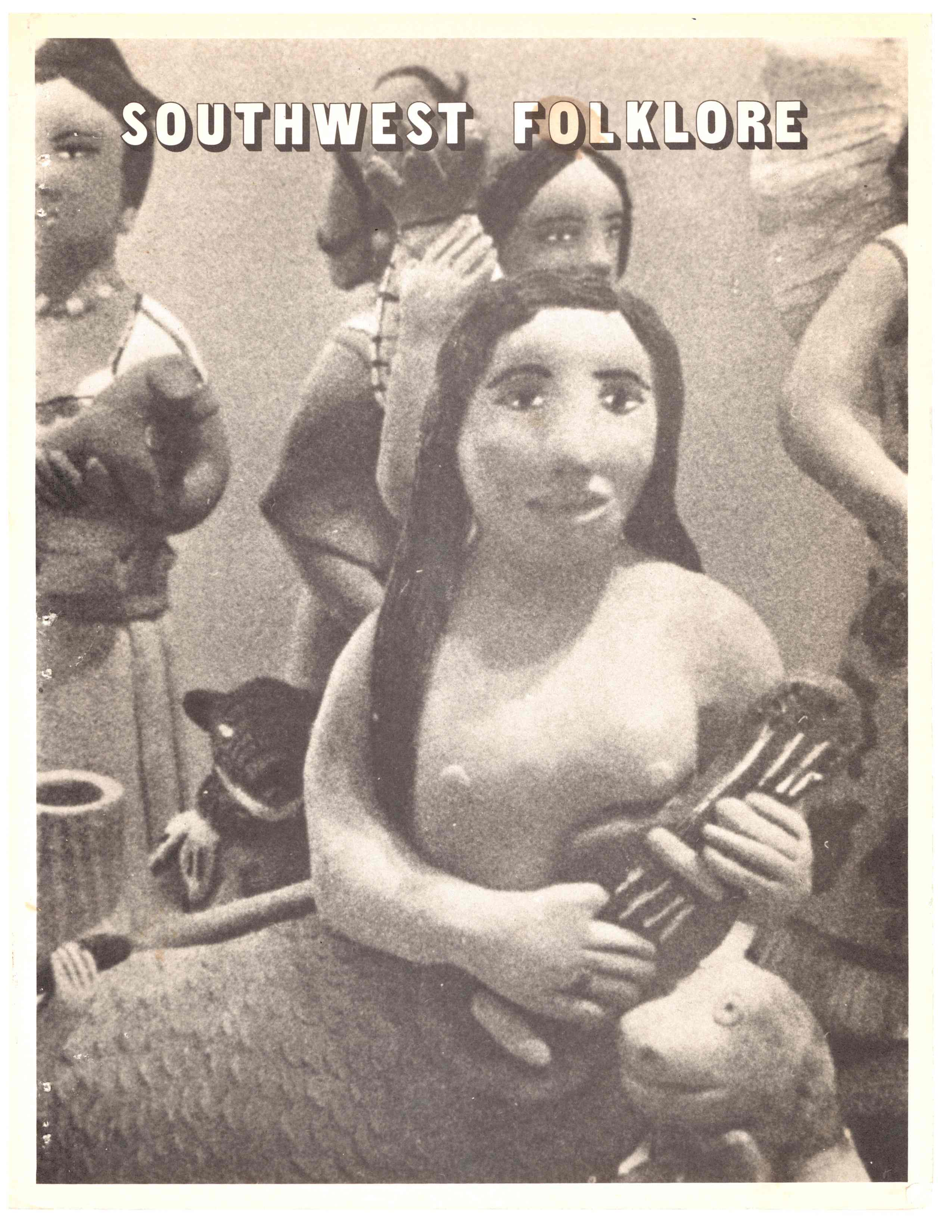
The Mermaid in Mexican Folk Creches
Erika Esau and George A. Boeck, Jr.
SOUTHWEST FOLKLORE Volume 5, Number 1 Winter 1981
The intent of this paper is to provide an example of a methodology with which hypotheses may be derived independently of ethnography. In the absence of ethnographic validation the conclusions put forward, while plausible, remain hypotheses awaiting verification. Were we to espouse a primary purpose, it would relate less to Weismann's mysteries than to the availability of folk art as a forum for interdisciplinary theorizing. The need for new approaches to the problems of folk art scholarship leads inevitably to more flexible and innovative adaptations of various methodologies. In this paper, we have proceeded from concepts of syncretism in folk religion and iconography in art history. 1
The initial inspiration for this paper was a curiosity engendered upon viewing an exhibition of Mexican folk art celebrating the Christmas season. The exhibition was first shown at the Art Museum of South Texas in Corpus Christi, Texas, in December 1972; it then traveled to Trinity University, San Antonio, and, in 1977, to the L.B.J. Library at the University of Texas at Austin. The exhibition was arranged so as to follow the Christmas season: December 12, La Fiesta de la Santissima Virgen de Guadalupe; December 16-24, Las Posadas; December 24, La Noche Buena; Christmas Day; December 26, Los Pastores; January 6, El Dia de los Santos Reyes; and February 2, Candelmas.fn2
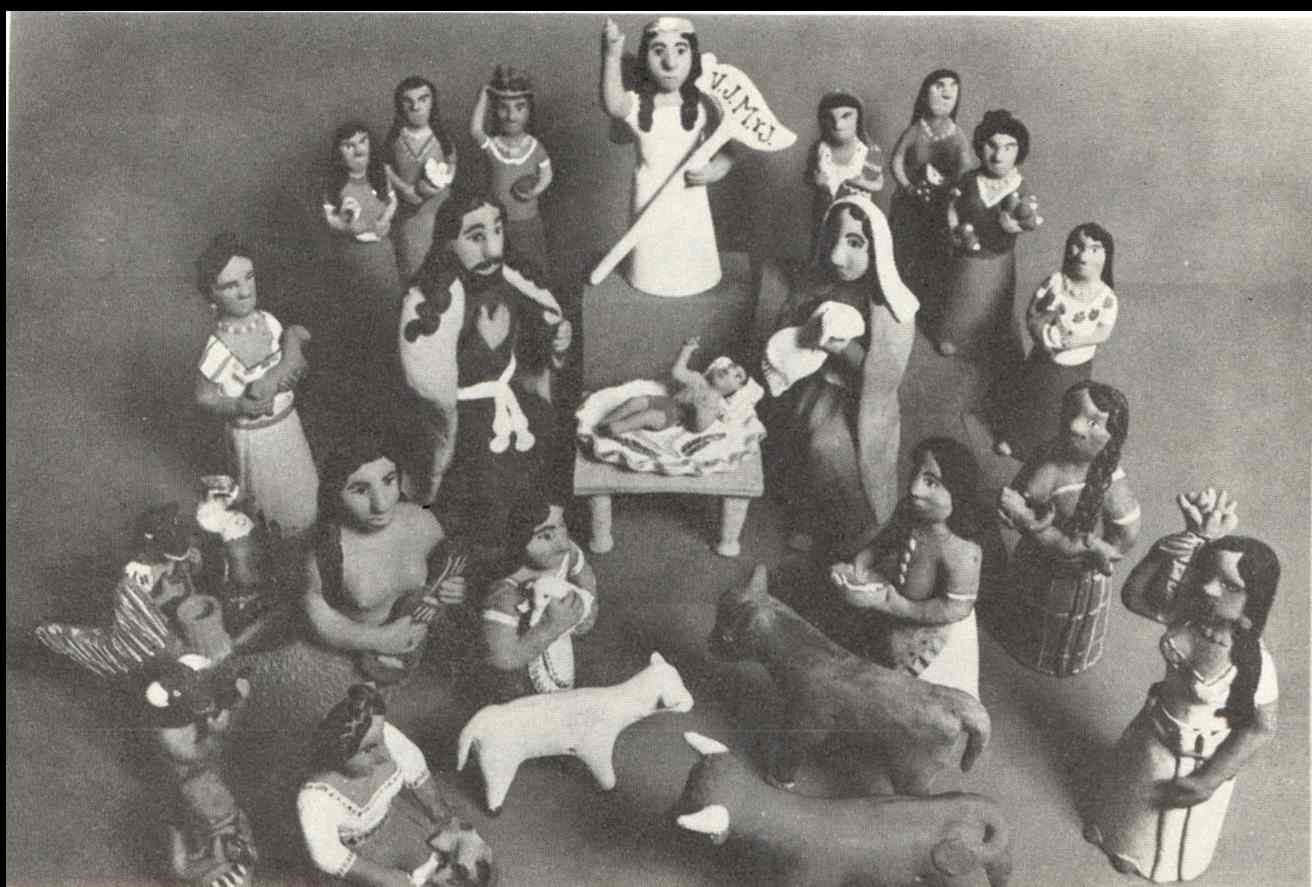
The folk ceramics used during La Noche Buena and Christmas Day are devoted to nativity scenes from Mexico. These are creches much like those throughout the Christian world, showing the infant Christ flanked by Joseph and Mary and an angel announcing the birth. In attendance are numerous figures from the community bringing offerings of food and gifts; the scene may also include a small band and manger animals. The arranging of the scene, according to Rubin de la Borbolla, is a family task "whose charm depends upon the ingenuity employed" in setting up the pieces.3
While in many Mexican creches the band is represented by
figurines portraying community members, one's curiosity is
piqued by those displays containing mythological creatures.
Rubin de la Borbolla comments that these creatures are usually
made exclusively for the Nativity scenes.4
An example of such a group, from Ocotlan, Oaxaca, includes a
mermaid on guitar and four attending musician figurines with
animal heads (rooster, dog or coyote, bull and a toad-like
creature).5
A question arises regarding their presence and the meaning of these figures in a Nativity scene. The placing of a mermaid, a "pagan" emblem, in a representation dedicated to a Christian theme presents particularly intriguing problems for the researcher; how did it get there and why? For a complete answer, one must consider several seemingly diverse factors: the origin and development of the creche; the mermaid's iconographical history; the anthropological and historical development of Mexican village life; and finally, elements and attributes of pre-Columbia mythology.
In his seminal work on the subject, Rudolf Berliner defines creches as "the special exhibition during the Christmas season of art objects representing the scene of the Nativity."6 Writing before World War II, he traced the first creche scene to a Jesuit church in Prague in 1562; the first to be erected in a home belonged to the Duchess of Amalfi some time before 1567, and was an elaborate affair consisting of 167 statuettes which represented, among other things, the Adoration, the Magi, a unicorn, a Lion of Judah, and a centaur (but no mermaid). Berliner was unable to find evidence of a popular or folk origin of the manger scene, stating, "we know enough about Christmas customs in ordinary homes to assert that, before 1600, in no country did the implements for the Christmas feast include a creche."7
Be that as it may, the creche, once conceived, became quite popular. The obvious educational function of such a visual representation of a Christian doctrine was not lost on the religious orders. As Ettlinger states, the manger scene was used in a fashion related to the Nativity play in which a personal rather than a liturgical approach to the story of salvation was emphasized. The custom was promoted by the Jesuits as a method of stimulating the imagination and senses of the beholder in order to cause greater participation in the holy events.8 The creche, then, became a form of biblia pauperum, and its popularity in Europe insured that the religious orders would introduce it in their foreign missions, as was the case in Latin America.
Such a visual and intrinsically informal element was easily adapted by the Mexican Indians into their own form of Christianity. This brings us back to the problem of the mermaid's presence in the Indians' Nativity scenes. In considering this problem, one must keep in mind that the mermaid was unheard of in pre-Hispanic Mexico and is, therefore, as much an assimilated concept as the creche is. It is necessary, then, to examine the original sources of this mythological idea.
The mermaid as a European concept may have had its origins in
the Babylonian god Oannes, who is represented with a flowing
beard and a fish's tail -- later as the Triton of Greek
mythology. In an act of synthetic interpolation, this
imaginary form was combined with another popular classical
source: the siren, that creature originally portrayed as a
half-woman and half-bird and who represented the souls of the
unhappy dead. Their association with sailors and the sea
stems from the fact that the sirens' singing was said to have
seduced Greek sailors to drive their ships onto the rocks.
A a very early date, seamen incorporated the powerful figure of
the siren into their mythology. In this context, it is
easy to understand the combination of the siren's attributes
with the more appropriate form of woman-fish; the Spanish la sirena and the French la siréne, both referring
to mermaid, attest to this transition.9

Mermaids as seen in a biblia pauperum. From Biblia Sacra Germanica, printed at Nuremberg, 1483. Victoria and Albert Museum. In: Benwell, the Sea Enchantress, London, 1961, pl 8a.
Visual representation of the mermaid became prevalent in the
Middle in English and Germanic heraldry, as well as in the
abundant bestiaries produced in monasteries to serve a largely
illiterate churchgoing populace. Here they sometimes symbolized
eloquence, perhaps the only desirable quality associated with
the figure in European tradition. Her more common attributes, as
a seductress driving men to their deaths, were impure love,
temptation, disgrace, wantonness, vanity, isolation and
insanity.10
Except as an ethereal singer, little in the European conception of the mermaid would explain her presence at the Nativity. One is led, therefore, to a consideration of the symbol system of the Mexican Indian villages in which the mermaid appeared after the Spanish conquest of the Aztecs.
At the time of the Conquest, Spanish missionaries, although violent in their suppression of non-Christian religious leaders, did make an attempt to preserve the traditional culture insofar as it did not conflict with Christian doctrine and orthodoxy.11 Consequently, a syncretic system of belief developed in which Catholicism was interwoven with the indigenous Indian traditions and religious practices. As Herskovits points out in his definition of syncretism, the similar elements in contacting cultures may be integrated in such a fashion as to merge the meanings of the forms while maintaining those forms intact.12 Redfield finds this to be exactly the case in the hinterlands of Mexico. Unlike the urban centers, the villages have naturalized Catholicism by interweaving the Indian tradition with it to such an extent that, he supposes, an investigator unfamiliar with Catholicism and Indian custom would not recognize the village religious customs as having come from two different heritages.13 Such a convergence of heritage is supported by a surprising number of basic similarities. A list is presented from numerous sources and refers specifically to Aztec theology: both religious cultures had confession and penance, both had a supernatural mother figure, both had a Eucharist, both had a Trinity (although the Aztec trinity lacked hypostasis), both had a hierarchical priesthood, the saint system was nearly enough equivalent to allow a tendency to assume the attributes of the Aztec pantheon.14
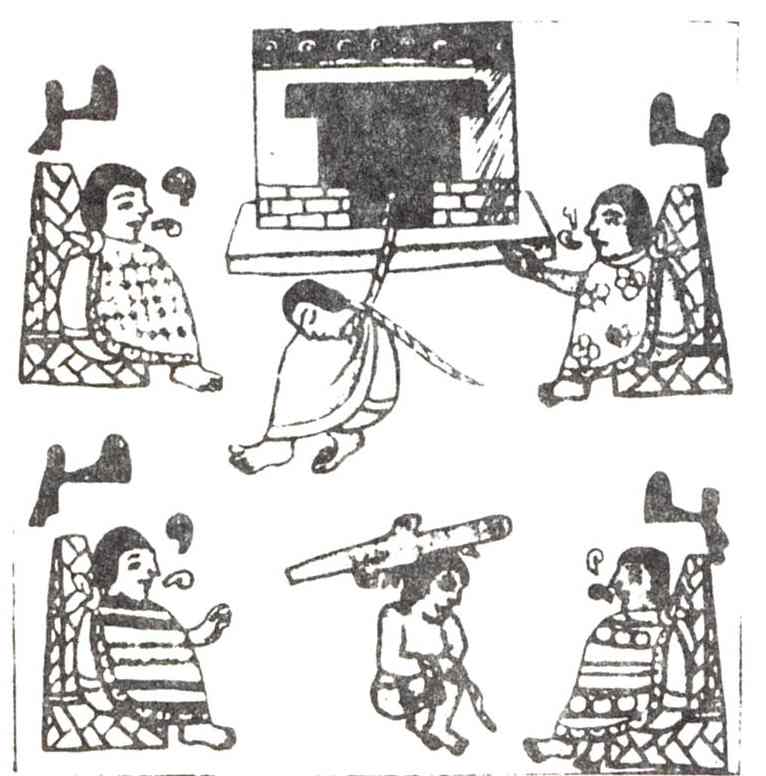
Four judges supervising execution of malefactors by noose and
club
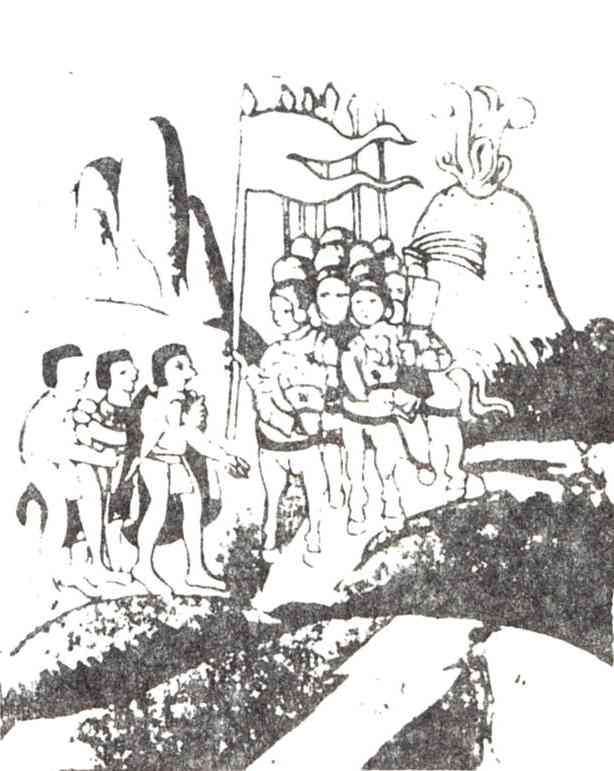
The conquistadors on their way to the capital meet a native
deputation
Examples from Sahagun's codices, ca 1529. In: Keleman, P., Medieval American Art, pl. 270.
This fusion of Spanish and native traits took place within the
first few generations after the Conquest; the process is
intriguingly evident in the arts, where Spanish and Indian
styles blend freely. As long as the theme avoided pre-Hispanic
religion, art was "assumed to be a thing of no practical
importance" and was, therefore, left to develop without
interference from the priest.15
The Indians, then, particularly in the more remote areas,
continued to practice their native arts, adopting elements and
motifs from Spanish sources as they needed them. Furthermore, as
natives were recruited to work on the building of churches, they
became increasingly aware of prevailing European art.16 One need only examine Mexican
codices of the sixteenth century to find evidence of this
influence: the tlacuiloque,
the illuminators of the manuscripts, gradually changed from the
cubistic line evidenced in the codices to chiaroscuro discovered
in the works of Morales and Murillo.17
Given this "hybridization process,"18 as Dr. Atl an artist and historian, describes it, one can assume that the mermaid figure was adapted by Indians who had at some time seen representations of her in Spanish sources; as Keleman states, "The leaf-sprite and the mermaid. . . may have entered the New World on maps and the title pages of books, where they are commonly found."19 The image began to appear in popular art as well as in colonial buildings and sculpture.
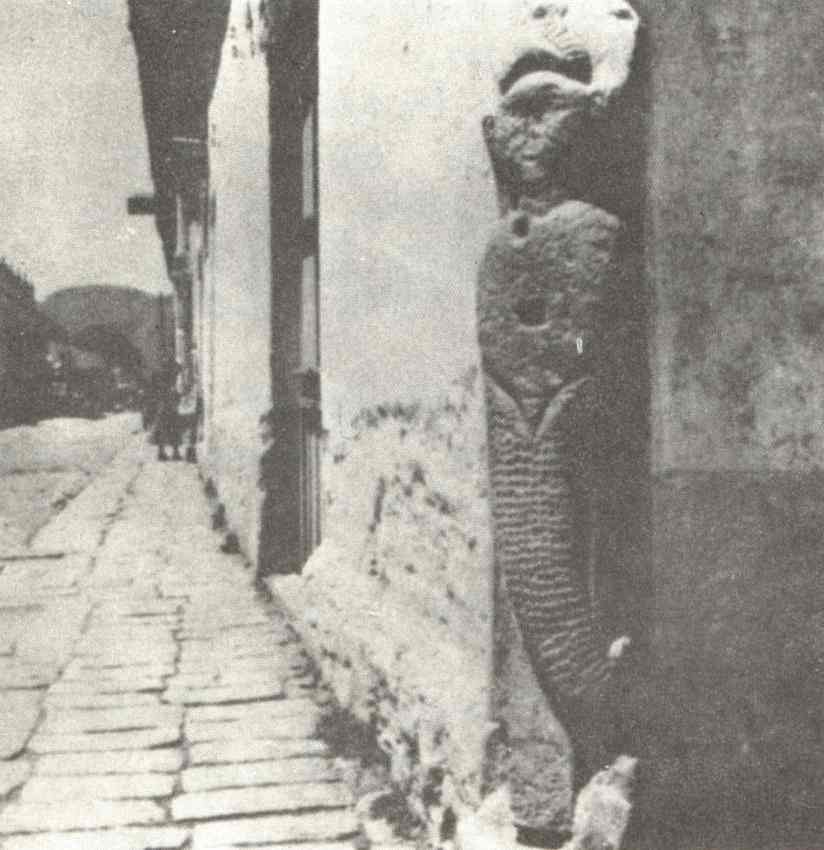
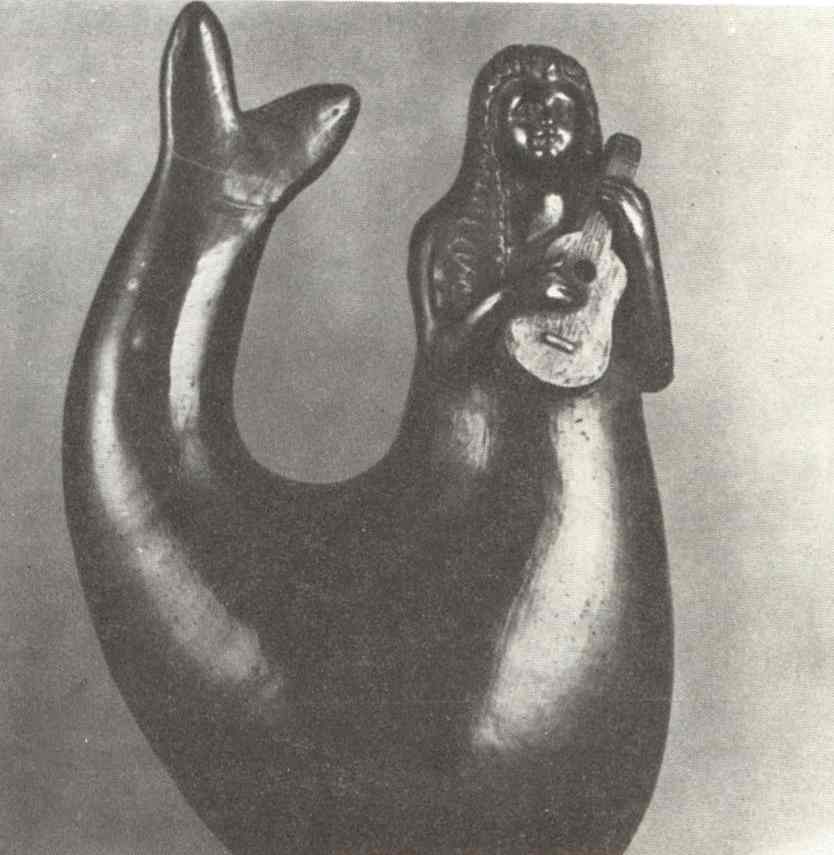
As mentioned previously, however, European concepts of the
mermaid cannot account for her extensive use in central Mexico
and in Nativity scenes. The Mexicans, moreover, have never been
seafaring. It appears that, while adopting this European form in
their art, the Indians understanding of its symbolism and
representational significance emerged from their indigenous
belief system.20 In order to
discover this native source, one must look to the pre-Hispanic
pantheon of gods and, most convincingly, to the goddess
Chalchiutlicue.
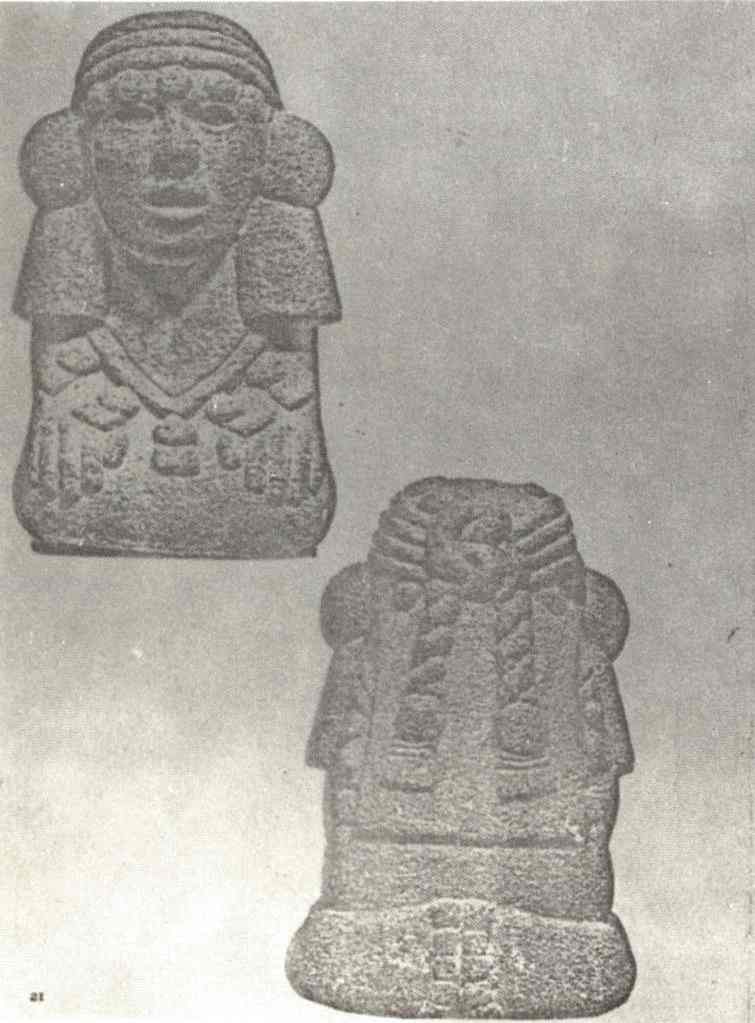
Among the Aztec deities, Chalchiutlicue was the wife of Tlaloc,
the god of rain and moisture. The name means "Lady of the
Emerald Robe," an allusion to the element over which she
presided. She is associated with both fresh and salt water,
having ruled earth during the fourth age of man, which ended in
a flood, causing men to become fish; she was consequently
considered to be the goddess of water sellers, fishermen, and
sea-farers.21 Further, Madsen
describes Chalchiutlicue as causing tempests and whirlwinds that
resulted in the drowning of boatmen.22
Such associations support the comparison with the mermaid in the
European tradition, since she was seen as an equivalent
"goddess" of the waters.
As for the mermaid-figure's presence at the birth of Christ,
the association with Chalchuitlicue is even more convincing. The
goddess was considered the Virgin Mother of the minor gods of
the heavens as well as of Huizilpochtli--the god of sun, war,
and one of the Aztec triumvirate.23
This link with Christian concepts is extended by
Chalchiutlicue's connection with the "green skirt" or "jewel
water" which denotes the "precious water of mortification" drawn
from the Penitent worshiper and containing the "life substance"
or "life blood."24
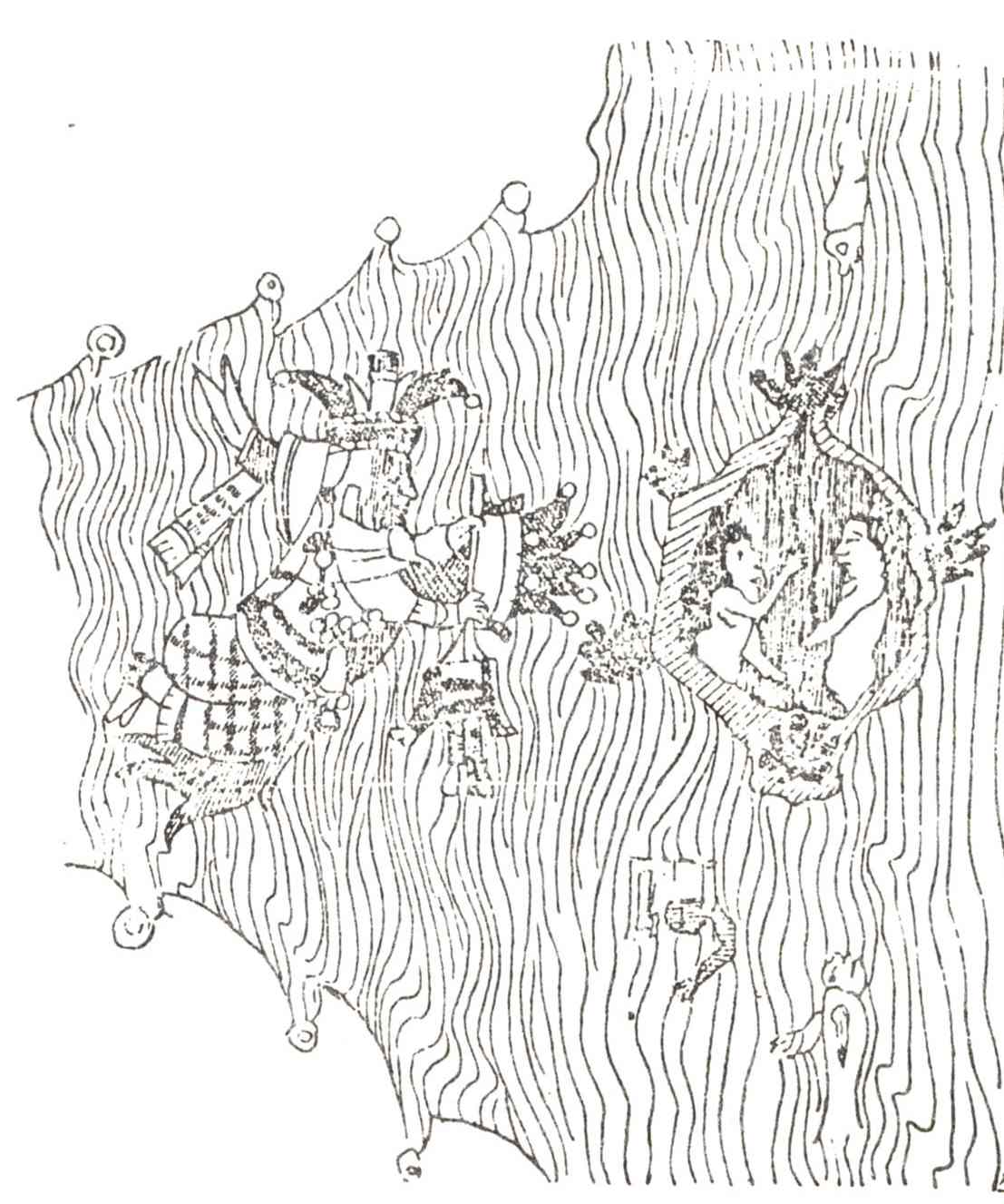
Figure 4: Chalchiutlicue as fish goddess in water
descending to first man and woman, survivors of
a deluge. Mackensie, Myths,
p. 22.
The goddess was also associated with pre-Hispanic baptism and naming ceremonies; water considered sacred to Chalchiutlicue was used by midwives to wash infants upon birth.25 She was also considered as a protectress of sucking infants. Furthermore, reference is often made to her connection with the symbolic pot, the "water pot" from which all life emerges and is sustained.26
Although known as the fish goddess, Chalchiutlicue's symbols were often the frog and snake; the nahuales, in which a human or immortal spirit could be transposed into a particular animal form, explains this act of symbolic "transfiguration."27 Weismann, in fact, maintains that this concept of animal duplicates was likely to encourage the adoption of the half-animal, half-human mermaid (the figures surrounding the mermaid in our creche scene may in fact represent nahuales; they, along with the mermaid, act as musicians.28 One can assume that the frog and snake symbols for Chalchuitlicue would have been prohibited by the Spanish as idolatrous. The adoption of a comparable European form, one most closely corresponding to the attributes of the pre-Hispanic goddess, would, then, be a matter of expedience.
In summary, then, the popularity and currency of the creche
during the Conquest of Mexico assured its introduction into the
New World by the religious orders. The clergy's emphasis on an
informal and personal educational role for the creche brought
about the inclusion of community members in the scene. Although
European attributes of the mermaid do not account for her
inclusion in the manger scene, they do provide a basis whereby
the Indians could apply attributes of their goddess
Chalchuitlicue to the form. As a personification of
Chalchuitlicue, Virgin Mother of the gods, protectress of
children, and baptismal figure, the mermaid's presence in the
manger scene is, in fact, appropriate. As one could
anticipate from Redfield's thesis, the bulk of the concepts
concerning the goddess Chalchuitlicue have been altered or
dropped in the intervening 400 years.29
In the absence of the native religious leadership, particularly
after the fall nagualism in the 1700s,30
the theological association of the mermaid as Chalchiutlicue's
symbol would continuously decline. One anticipates, further,
that the elaboration of the Maria cult would make serious
inroads into the complex surrounding the Indian Virgin Mother
until the presence of a mermaid in a creche scene would evoke
domestic rather than theological images.
The benefits of such a methodology rest on its capacity to arrive at intriguing hypotheses independent of ethnographic description. Here, we assert that the mermaid figurine in the Mexican folk creche originated as an element of a biblia pauperum through which the pre-Hispanic symbolic complex associated with Chalchiutlicue could be expressed. In the absence of ethnography or ethnohistory, an iconographic approach aptly provides native meaning to this classical mythological form found along with a Mexican Indian nahuale
band playing at the Christian Nativity.
1. We would like to thank several people who have helped us recognize some of this paper's implications concerning flexibility of use, intent and meaning of folk-art objects. In particular, we must mention Charlene Cerny, Curator of American/Latin American Folk Art at the Museum of International Folk Art, Santa Fe, New Mexico. Ms. Cerny, in several correspondences, has been extremely insightful and
encouraging in her suggestions and experienced opinion. Further, we are grateful to Merle Wachter, currently at the University of Mexico in San Antonio, Texas, and Steve Vollmer, also of San Antonio; both were quite illuminating concerning Mexican crafts practices.
2. Winn, R.K. Viva Jesus, Maria y Jose; A Celebration of the Birth of Jesus. San Antonio, Tx., 1977, pp. 3-5.
3. Rubin de la Borbolla, D. F. "Arte Popular de Mexico," Special ed. Artes de Mexico, 1963, p.8.
4. Ibid.
5. Further investigation indicates that this particular mermaid figure may not be an original part of this creche scene; it may have been added later by the collector himself. The question then arises whether a mermaid would appear in creches in situ. At this point, our only evidence is second-hand. During a telephone conversation, Stephanie Kosicki, Santa Fe, New Mexico, current owner of this particular creche as well as many others, told us that her informants at the Museum in Juarez, Mexico, state that they have often seen mermaids in home creches. Further corroboration of the practice is, of course, necessary before our thesis could be considered more than suggestive.
6. Berliner, R. "The Origins of the Creche," Gazette des Beauz-Arts, 30 (1946), p. 251.
7. Ibid., p. 271. Art historical opinion on this point varies. Some scholars contend that the creche is an outgrowth of the presepio used in early Italian church plays (we thank Prof. Dale Kinney of Bryn Mawr College for this insight.) Berliner's statement, however, is substantiated enough to remain trustworthy. For further discussion of the presepio, see N. de Robeck, The Christmas Crib, Milwaukee
1956. For a most interesting consideration of the Christmas crib in Puerto Rico, see Yvonne Lange's dissertation, Santos: The Household Wooden Saints of Puerto Rico, Ph.D. University of Pennsylvania 1975, pp. 89-112.
8. Ettlinger, L.D. "Review: Die Weihnachtskrippe by Berlinger," Burlington Magazine, 99 (1957), p. 167.
9. It is interesting to note that, in the Odyssey, no mention is ever made of the siren's physical form. See G. Benwell, The Sea Enchantress, London 1961.
10. Lima, F. de Castro Pires de. A sereia, Porto 1952, p. 99.
11. Scholes, F.V. "Beginning of Hispano-Indian Society in Yucutan," Science Monthly, 44 (1937), p. 532. Oppression of the Indians, exacerbated by the devastating effects of disease and wide-spread slaughter, became so bad that Charles V was forced to lay down an edict stating that the religious and military leaders should ease their efforts against the natives; the Spanish government was aware that
they needed Indian labor to retrieve the riches of the mines and the land. See also Liss, P.K. Mexico under Spain 1521-1556, Chicago 1975.
12. Herskovits, M.J. "Syncretism," in Standard Dictionary of Folklore, Mythology and Legend, New York 1950, p. 1097.
13. Redfield, R. Folk Culture of Yucutan, Chicago 1941, p. 102-103.
14. Although Sahagun recognized that the extensive use of native equivalents for Spanish terms led to a superficial comprehension of doctrine, he and his colleagues at the College of the Holy Cross in the 1530's followed Philip II's admonition to adapt Aztec metaphor for use in the administration of sacraments and teaching. See Dibble, C. "The Nahuatlization of Christianity," in M. S. Edmonson,
Sixteenth Century Mexico: The Work of Sahagun, Albuquerque 1974, p. 226.
15. Weismann, E.W. Mexico in Sculpture 1521-1821, Cambridge, Mass., 1950, p. 2.
16. In his article "Colonial Art," Toussaint maintains that the first period of Mexican colonial art was noteworthy for the survivals from the Middle Ages. In any case, the stone work of colonial churches in this era was marked by Indian influences on European forms. See M. Toussaint in Twenty Centuries of Mexican Art, New York 1940, p. 67. On the fusion of Spanish and Mexican art, see also P. Keleman, Baroque and Rococo in Latin America, Art and Architecture in Spain and Portugal and Their American Dominions 1500 to 1800, London 1959.
17. Chariot, J. "Saints and Santos," Liturgical Arts 24 (1955),p.79.
18. Dr. Atl (Gerardo Murillo), Las Artes Populares en Mexico, Mexico 1922, p. 15.
19. Keleman, P. op. cit.,p. 203. Keleman also talks of the importance of Antwerp prints in the Spanish colonies, most notably the work of Christopher Plantin, the printer appointed by Philip II to print the Empire's breviaries and missals. For examples of mermaid images appearing in Plantin's work of this time, see S. Harvard, Ornamental Initials; The Woodcut Initials of Christopher Plantin, New York 1974. Note Cat. no. 2, letters "F" and "T"; Cat. no. 12, letter "T"; and Cat. no. 17, letter"Y".
20. Boas comments in this regard that the form of a piece rather than the indigenous associative connotations determines the perceiver's recognition of aesthetic quality. See F. Boas, Primitive Art, p. 26.
21. Mackensie, D.A. Myths of Pre-Columbian America, Gresham, Ore. (1873?), p. 198.
22. Madsen, W. "Christo-Paganism: A Study of Mexican Religious Symbolism," in M.S. Edmonson, Nativism and Syncretism, New Orleans 1960, p. 120.
23. King, A.R. "Mesoamerica," in R. Spencer, The Native Americans, New York 1955, p. 484.
24. Mackensie, op. cit., p. 205.
25. Sullivan, T.D. "The Rhetorical Orations...Collected by Sahagun," in M.S. Edmonson, Sixteenth Century Mexico, p. 95, and E.C. Parsons, Mitla: Town of Souls, Chicago 1936, p. 236.
26. Mackensie, op. cit.,p. 205.
27. For a discussion of the idea of nahuales, see Foster, G.M. "Nagulaism in Mexico and Guatemala," Acta Americana, 2 (1944), pp. 85-103.
28. Weismann, op. cit., p. 107. Charlene Cerny points out to us that these figures do not look like other figures called nagaules; there is, however, no reason to assume that these representations could not be another form of the same concept.
29. Redfield, op. cit., p. 87.
30. See Foster, op. cit.