John Muir
The Mountains of California
Chapter XVI The Bee-Pastures
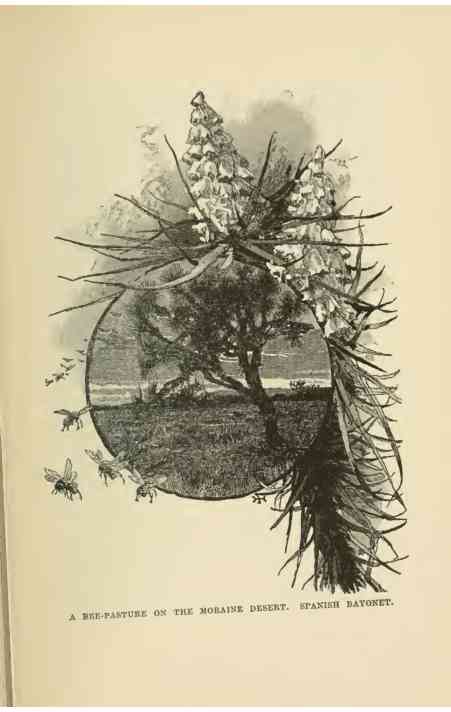
When California was wild, it was one sweet bee-garden throughout its entire length, north and south, and all the way across from the snowy Sierra to the ocean. Wherever a bee might fly within the bounds of this virgin wilderness — through the redwood forests, along the banks of the rivers, along the bluffs and headlands fronting the sea, over valley and plain, park and grove, and deep, leafy glen, or far up the piny slopes of the mountains — throughout every belt and section of climate up to the timber line, bee-flowers bloomed in lavish abundance. Here they grew more or less apart in special sheets and patches of no great size, there in broad, flowing folds hundreds of miles in length — zones of polleny forests, zones of flowery chaparral, stream-tangles of rubus and wild rose, sheets of golden composite, beds of violets, beds of mint, beds of bryanthus and clover, and so on, certain species blooming somewhere all the year round. But of late years plows and sheep have made sad havoc in these glorious pastures, destroying tens of thousands of the flowery acres like a fire, and banishing many species of the best honey-plants to
page 339
rocky cliffs and fence-corners, while, on the other hand, cultivation thus far has given no adequate compensation, at least in kind; only acres of alfalfa for miles of the richest wild pasture, ornamental roses and honeysuckles around cottage doors for cascades of wild roses in the dells, and small, square orchards and orange groves for broad mountain-belts of chaparral. The Great Central Plain of California, during the months of March, April, and May, was one smooth, continuous bed of honey-bloom, so marvelously rich that, in walking from one end of it to the other, a distance of more than 400 miles, your foot would press about a hundred flowers at every step. Mints, gilias, nemophilas, castilleias, and innumerable composite were so crowded together that, had ninety-nine per cent, of them been taken away, the plain would still have seemed to any but Californians extravagantly flowery. The radiant, honeyful corollas, touching and overlapping, and rising above one another, glowed in the living light like a sunset sky — one sheet of purple and gold, with the bright Sacramento pouring through the midst of it from the north, the San Joaquin, from the south, and their many tributaries sweeping in at right angles from the mountains, dividing the plain into sections fringed with trees. Along the rivers there is a strip of bottom-land, countersunk beneath the general level, and wider toward the foot-hills, where magnificent oaks, from three to eight feet in diameter, cast grateful masses of shade over the open, prairie-like levels. And close along the water's edge there was a fine jungle
[page] 340
of tropical luxuriance, composed of wild-rose and bramble bushes and a great variety of climbing vines, wreathing and interlacing the branches ard trunks of willows and alders, and swinging across from summit to summit in heavy festoons. Here the wild bees reveled in fresh bloom long after the flowers of the drier plain had withered and gone to seed. And in midsummer, when the "blackberries" were ripe, the Indians came from the mountains to feast — men, women, and babies in long, noisy trains, often joined by the farmers of the neighborhood, who gathered this wild fruit with commendable appreciation of its superior flavor, while their home orchards were full of ripe peaches, apricots, nectarines, and figs, and their vineyards were laden with grapes. But, though these luxuriant, shaggy rivebeds were thus distinct from the smooth, treeless plain, they made no heavy dividing lines in general views. The whole appeared as one continuous sheet of bloom bounded only by the mountains. When I first saw this central garden, the most extensive and regular of all the bee-pastures of the State, it seemed all one sheet of plant gold, hazy and vanishing in the distance, distinct as a new map along the foothills at my feet. Descending the eastern slopes of the Coast Range through beds of gilias and lupines, and around many a breezy hillock and bush-crowned headland, I at length waded out into the midst of it. All the ground was covered, not with grass and green leaves, but with radiant corollas, about ankle-deep next the foot-hills, knee-deep or more five or six
[illus. page 341]
[page 342]
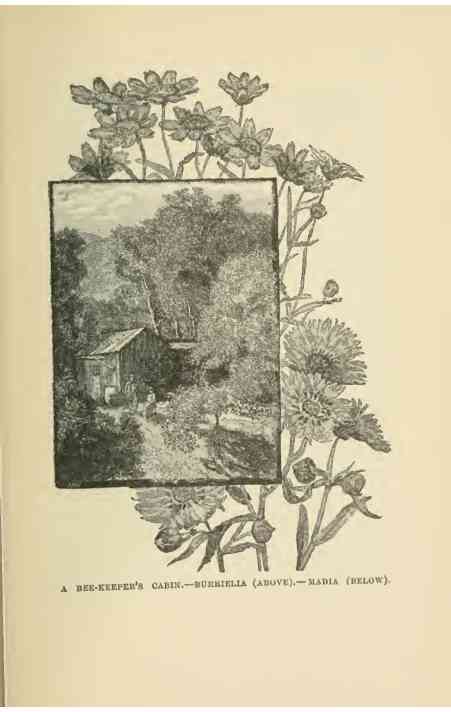
miles out. Here were bahia, madia, madaria, burrielia, chrysopsis, corethrogyne, grindelia, etc., growing iu close social congregations of various shades of yellow, blending finely with the purples of clarkia, orthocarpus, and Oenothera, whose delicate petals were drinking the vital sunbeams without giving back any sparkling glow. Because so long a period of extreme drought succeeds the rainy season, most of the vegetation is composed of annuals, which spring up simultaneously, and bloom together at about the same height above the ground, the general surface being but slightly ruffled by the taller phacelias, pentstemons, and groups of Salvia carduacea, the king of the mints. Sauntering in any direction, hundreds of these happy sun-plants brushed against my feet at every step, and closed over them as if I were wading in liquid gold. The air was sweet with fragrance, the larks sang their blessed songs, rising on the wing as I advanced, then sinking out of sight in the polleny sod, while myriads of wild bees stirred the lower air with their monotonous hum — monotonous, yet forever fresh and sweet as everyday sunshine. Hares and spermophiles showed themselves in considerable numbers in shallow places, and small bands of antelopes were almost constantly in sight, gazing curiously from some slight elevation, and then bounding swiftly away with unrivaled grace of motion. Yet I could discover no crushed flowers to mark their track, nor, indeed, any destructive action of any wild foot or tooth whatever. The great yellow days circled by uncounted, while I drifted toward the north, observing the
page 343
countless forms of life thronging about me, lying down almost anywhere on the approach of night. And what glorious botanical beds I had! Oftentimes on awaking I would find several new species leaning over me and looking me full in the face, so that my studies would begin before rising. About the first of May I turned eastward, crossing the San Joaquin River between the mouths of the Tuolumne and Merced, and by the time I had reached the Sierra foot-hills most of the vegetation had gone to seed and become as dry as hay. All the seasons of the great plain are warm or temperate, and bee-flowers are never wholly wanting; but the grand springtime — the annual resurrection — is governed by the rains, which usually set in about the middle of November or the beginning of December. Then the seeds, that for six months have lain on the ground dry and fresh as if they had been gathered into barns, at once unfold their treasured life. The general brown and purple of the ground, and the dead vegetation of the preceding year, give place to the green of mosses and liverworts and myriads of young leaves. Then one species after another comes into flower, gradually overspreading the green with yellow and purple, which lasts until May. The "rainy season" is by no means a gloomy, soggy period of constant cloudiness and rain. Perhaps nowhere else in North America, perhaps in the world, are the months of December, January, February, and March so full of bland, plant-building sunshine. Referring to my notes of the winter and spring of 1868-69, every day of which I spent
[page] 344
out of doors, on that section of the plain lying between the Tuolumne and Merced rivers, I find that the first rain of the season fell on December 18th. January had only six rainy days — that is, days on which rain fell; February three, March five, April three, and May three, completing the so-called rainy season, which was about an average one. The ordinary rain-storm of this region is seldom very cold or violent. The winds, which in settled weather come from the northwest, veer round into the opposite direction, the sky fills gradually and evenly with one general cloud, from which the rain falls steadily, often for days in succession, at a temperature of about 45° or 50°. More than seventy-five per cent, of all the rain of this season came from the northwest, down the coast over southeastern Alaska, British Columbia, Washington, and Oregon, though the local winds of these circular storms blow from the southeast. One magnificent local storm from the northwest fell on March 21. A massive, round-browed cloud came swelling and thundering over the flowery plain in most imposing majesty, its bossy front burning white and purple in the full blaze of the sun, while warm rain poured from its ample fountains like a cataract, beating down flowers and bees, and flooding the dry watercourses as suddenly as those of Nevada are flooded by the so-called "cloud-bursts." But in less than half an hour not a trace of the heavy, mountain-like cloud-structure was left in the sky, and the bees were on the wing, as if nothing more gratefully refreshing could have been sent them.
[page] 345
By the end of January four species of plants were in flower, and five or six mosses had already adjusted their hoods and were in the prime of life; but the flowers were not sufficiently numerous as yet to affect greatly the general green of the young leaves. Violets made their appearance in the first week of February, and toward the end of this month the warmer portions of the plain were already golden with myriads of the flowers of rayed composite. This was the full springtime. The sunshine grew warmer and richer, new plants bloomed every day; the air became more tuneful with humming wings, and sweeter with the fragrance of the opening flowers. Ants and ground squirrels were getting ready for their summer work, rubbing their benumbed limbs, and sunning themselves on the husk-piles before their doors, and spiders were busy mending their old webs, or weaving new ones. In March, the vegetation was more than doubled in depth and color; claytonia, calandrinia, a large white gilia, and two nemophilas were in bloom, together with a host of yellow composite, tall enough now to bend in the wind and show wavering ripples of shade. In April, plant-life, as a whole, reached its greatest height, and the plain, over all its varied surface, was mantled with a close, furred plush of purple and golden corollas. By the end of this month, most of the species had ripened their seeds, but undecayed, still seemed to be in bloom from the numerous corolla-like involucres and whorls of chaffy scales of the composite. In May, the bees
[page] 346
found in flower only a few deep-set liliaceous plants and eriogonums. June, July, August, and September is the season of rest and sleep, — a winter of dry heat, — followed in October by a second outburst of bloom at the very driest time of the year. Then, after the shrunken mass of leaves and stalks of the dead vegetation crinkle and turn to dust beneath the foot, as if it had been baked in an oven, Hemizonia virgata, a slender, unobtrusive little plant, from six inches to three feet high, suddenly makes its appearance in patches miles in extent, like a resurrection of the bloom of April. I have counted upward of 3000 flowers, five eighths of an inch in diameter, on a single plant. Both its leaves and stems are so slender as to be nearly invisible, at a distance of a few yards, amid so showy a multitude of flowers. The ray and disk flowers are both yellow, the stamens purple, and the texture of the rays is rich and velvety, like the petals of garden pansies. The prevailing wind turns all the heads round to the southeast, so that in facing northwestward we have the flowers looking us in the face. In my estimation, this little plant, the last born of the brilliant host of composite that glorify the plain, is the most interesting of all. It remains in flower until November, uniting with two or three species of wiry eriogonums, which continue the floral chain around December to the spring flowers of January. Thus, although the main bloom and honey season is only about three months long, the floral circle, however thin around some of the hot, rainless months, is never completely broken.
[page] 347
How long the various species of wild bees have lived in this honey-garden, nobody knows; probably ever since the main body of the present flora gained possession of the land, toward the close of the glacial period. The first brown honey-bees brought to California are said to have arrived in San Francisco in March, 1853. A bee-keeper by the name of Shelton purchased a lot, consisting of twelve swarms, from some one at Aspinwall, who had brought them from New York. When landed at San Francisco, all the hives contained live bees, but they finally dwindled to one hive, which was taken to San Jose. The little immigrants flourished and multiplied in the bountiful pastures of the Santa Clara Valley, sending off three swarms the first season. The owner was killed shortly afterward, and in settling up his estate, two of the swarms were sold at auction for $105 and $110 respectively. Other importations were made, from time to time, by way of the Isthmus, and, though great pains were taken to insure success, about one half usually died on the way. Four swarms were brought safely across the plains in 1859, the hives being placed in the rear end of a wagon, which was stopped in the afternoon to allow the bees to fly and feed in the floweriest places that were within reach until dark, when the hives were closed. In 1855, two years after the time of the first arrivals from New York, a single swarm was brought over from San Jose, and let fly in the Great Central Plain. Bee-culture, however, has never gained much attention here, notwithstanding the extraor-
[page] 348
dinary abundance of honey-bloom, and the high price of honey during the early years. A few hives are found here and there among settlers who chanced to have learned something about the business before coming to the State. But sheep, cattle, grain, and fruit raising are the chief industries, as they require less skill and care, while the profits thus far have been greater. In 1856 honey sold here at from one and a half to two dollars per pound. Twelve years later the price had fallen to twelve and a half cents. In 1868 I sat down to dinner with a band of ravenous sheep-shearers at a ranch on the San Joaquin, where fifteen or twenty hives were kept, and our host advised us not to spare the large pan of honey he had placed on the table, as it was the cheapest article he had to offer. In all my walks, however, I have never come upon a regular bee-ranch in the Central Valley like those so common and so skilfully managed in the southern counties of the State. The few pounds of honey and wax produced are consumed at home, and are scarcely taken into account among the coarser products of the farm. The swarms that escape from their careless owners have a weary, perplexing time of it in seeking suitable homes. Most of them make their way to the foot-hills of the mountains, or to the trees that line the banks of the rivers, where some hollow log or trunk may be found. A friend of mine, while out hunting on the San Joaquin, came upon an old coon trap, hidden among some tall grass, near the edge of the river, upon which he sat down to rest. Shortly afterward his attention was attracted to a crowd
[page] 349
of angry bees that were flying excitedly about his head, when he discovered that he was sitting upon their hive, which was found to contain more than 200 pounds of honey. Out in the broad, swampy delta of the Sacramento and San Joaquin rivers, the little wanderers have been known to build their combs in a bunch of rushes, or stiff, wiry grass, only slightly protected from the weather, and in danger every spring of being carried away by floods. They have the advantage, however, of a vast extent of fresh pasture, accessible only to themselves. The present condition of the Grand Central Garden is very different from that we have sketched. About twenty years ago, when the gold placers had been pretty thoroughly exhausted, the attention of fortune-seekers — not home-seekers — was, in great part, turned away from the mines to the fertile plains, and many began experiments in a kind of restless, wild agriculture. A load of lumber would be hauled to some spot on the free wilderness, where water could be easily found, and a rude box-cabin built. Then a gang-plow was procured, and a dozen mustang ponies, worth ten or fifteen dollars apiece, and with .these hundreds of acres were stirred as easily as if the land had been under cultivation for years, tough, perennial roots being almost wholly absent. Thus a ranch was established, and from these bare wooden huts, as centers of desolation, the wild flora vanished in ever widening circles. But the arch destroyers are the shepherds, with their flocks of hoofed locusts, sweeping over the ground like a fire, and trampling down every rod that escapes the plow
[page] 350
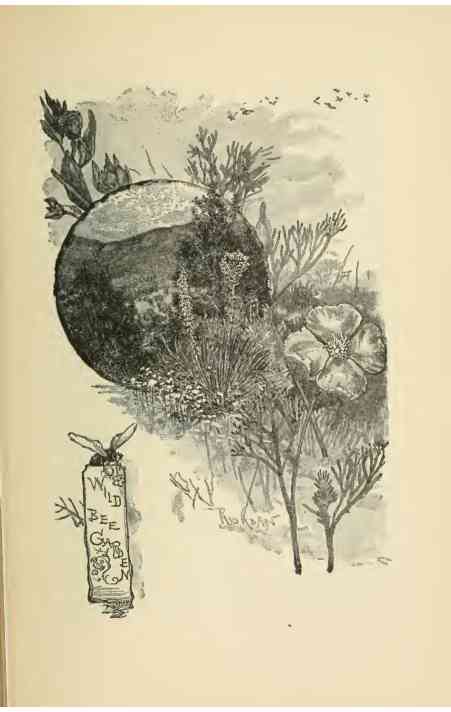
as completely as if the whole plain were a cottage garden-plot without a fence. But notwithstanding these destroyers, a thousand swarms of bees may be pastured here for every one now gathering honey. The greater portion is still covered every season with a repressed growth of bee-flowers, for most of the species are annuals, and many of them are not relished by sheep or cattle, while the rapidity of their growth enables them to develop and mature their seeds before any foot has time to crush them. The ground is, therefore, kept sweet, and the race is perpetuated, though only as a suggestive shadow of the magnificence of its wildness. The time will undoubtedly come when the entire area of this noble valley will be tilled like a garden, when the fertilizing waters of the mountains, now flowing to the sea, will be distributed to every acre, giving rise to prosperous towns, wealth, arts, etc. Then, I suppose, there will be few left, even among botanists, to deplore the vanished primeval flora. In the mean time, the pure waste going on — the wanton destruction of the innocents — is a sad sight to see, and the sun may well be pitied in being compelled to look on. The bee-pastures of the Coast Ranges last longer and are more varied than those of the great plain, on account of differences of soil and climate, moisture, and shade, etc. Some of the mountains are upward of 4000 feet in height, and small streams, springs, oozy bogs, etc., occur in great abundance and variety in the wooded regions, while open parks, flooded with sunshine, and hill-girt valleys lying at different elevations, each with
[page] 351
its own peculiar climate and exposure, possess the required conditions for the development of species and families of plants widely varied. Next the plain there is, first, a series of smooth hills, planted with a rich and showy vegetation that differs but little from that of the plain itself — as if the edge of the plain had been lifted and bent into flowing folds, with all its flowers in place, only toned down a little as to their luxuriance, and a few new species introduced, such as the hill lupines, mints, and gilias. The colors show finely when thus held to view on the slopes; patches of red, purple, blue, yellow, and white, blending around the edges, the whole appearing at a little distance like a map colored in sections. Above this lies the park and chaparral region, with oaks, mostly evergreen, planted wide apart, and blooming shrubs from three to ten feet high; manzanita and ceanothus of several species, mixed with rhamnus, cercis, pickeringia, cherry, amelanchier, and adenostoma, in shaggy, interlocking thickets, and many species of hosackia, clover, monardella, castilleia, etc., in the openings. The main ranges send out spurs somewhat parallel to their axes, inclosing level valleys, many of them quite extensive, and containing a great profusion of sun-loving bee-flowers in their wild state; but these are, in great part, already lost to the bees by cultivation. Nearer the coast are the giant forests of the redwoods, extending from near the Oregon line to Santa Cruz. Beneath the cool, deep shade of these maiestic trees the ground is occupied by ferns,
[page] 352
chiefly woodwardia and aspidiums, with only a few flowering plants — oxalis, trientalis, erythroninm, fritillaria, smilax, and other shade-lovers. Bnt all along the redwood belt there are snnny openings on hill-slopes looking to the south, where the giant trees stand back, and give the ground to the small sunflowers and the bees. Around the lofty redwood walls of these little bee-acres there is usually a fringe of Chestnut Oak, Laurel, and Madrono, the last of which is a surpassingly beautiful tree, and a great favorite with the bees. The trunks of the largest specimens are seven or eight feet thick, and about fifty feet high ; the bark red and chocolate colored, the leaves plain, large, and glossy, like those of Magnolia grandiflora, while the flowers are yellowish-white, and urn-shaped, in well-proportioned panicles, from five to ten inches long. When in full bloom, a single tree seems to be visited at times by a whole hive of bees at once, and the deep hum of such a multitude makes the listener guess that more than the ordinary work of honey-winning must be going on. How perfectly enchanting and care-obliterating are these withdrawn gardens of the woods — long vistas opening to the sea — sunshine sifting and pouring upon the flowery ground in a tremulous, shifting mosaic, as the lightways in the leafy wall open and close with the swaying breeze — shining leaves and flowers, birds and bees, mingling together in springtime harmony, and soothing fragrance exhaling from a thousand thousand fountains! In these balmy, dissolving days, when the deep heart-beats of Nature are felt thrilling rocks
[page] 353
and trees and everything alike, common business and friends are happily forgotten, and even the natural honey-work of bees, and the care of birds for their young, and mothers for their children, seem slightly out of place. To the northward, in Humboldt and the adjacent counties, whole hillsides are covered with rhododendron, making a glorious melody of bee-bloom in the spring. And the Western azalea, hardly less flowery, grows in massy thickets three to eight feet high around the edges of groves and woods as far south as San Luis Obispo, usually accompanied by manzanita; while the valleys, with their varying moisture and shade, yield a rich variety of the smaller honey-flowers, such as mentha, lycopus, micromeria, audibertia, trichostema, and other mints; with vaccinium, wild strawberry, geranium, Calais, and goldenrod; and in the cool glens along the stream-banks, where the shade of trees is not too deep, spiraea, dogwood, heteromeles, and calycanthus, and many species of rubus form interlacing tangles, some portion of which continues in bloom for months. Though the coast region was the first to be invaded and settled by white men, it has suffered less from a bee point of view than either of the other main divisions, chiefly, no doubt, because of the unevenness of the surface, and because it is owned and protected instead of lying exposed to the flocks of the wandering "sheepmen." These remarks apply more particularly to the north half of the coast. Farther south there is less moisture, less forest shade, and the honey flora is less varied.
[page] 354
The Sierra region is the largest of the three main divisions of the bee-lands of the State, and the most regularly varied in its subdivisions, owing to their gradual rise from the level of the Central Plain to the alpine summits. The foot-hill region is about as dry and sunful, from the end of May until the setting in of the winter rains, as the plain. There are no shady forests, no damp glens, at all like those lying at the same elevations in the Coast Mountains. The social composite of the plain, with a few added species, form the bulk of the herbaceous portion of the vegetation up to a height of 1500 feet or more, shaded lightly here and there with oaks and Sabine Pines, and interrupted by patches of ceanothus and buckeye. Above this, and just below the forest region, there is a dark, heath-like belt of chaparral, composed almost exclusively of Adenostoma fasciculata, a bush belonging to the rose family, from five to eight feet high, with small, round leaves in fascicles, and bearing a multitude of small white flowers in panicles on the ends of the upper branches. Where it occurs at all, it usually covers all the ground with a close, impenetrable growth, scarcely broken for miles. Up through the forest region, to a height of about 9000 feet above sea-level, there are ragged patches of manzanita, and five or six species of ceanothus, called deer-brush or California lilac. These are the most important of all the honey-bearing bushes of the Sierra. CJiamcebatia folioJosa, a little shrub about a foot high, with flowers like the strawberry, makes handsome carpets beneath the pines, and seems to be a favorite with the bees; while
[page] 355
pines themselves furnish unlimited quantities of pollen and honey-dew. The product of a single tree, ripening its pollen at the right time of year, would be sufficient for the wants of a whole hive. Along the streams there is a rich growth of lilies, larkspurs, pedicularis, castilleias, and clover. The alpine region contains the flowery glacier meadows, and countless small gardens in all sorts of places full of potentilla of several species, spraguea, ivesia, epilobium, and goldenrod, with beds of bryanthus and the charming cassiope covered with sweet bells. Even the tops of the mountains are blessed with flowers, — dwarf phlox, polemonium, ribes, hulsea, etc. I have seen wild bees and butterflies feeding at a height of 13,000 feet above the sea. Many, however, that go up these dangerous heights never come down again. Some, undoubtedly, perish in storms, and I have found thousands lying dead or benumbed on the surface of the glaciers, to which they had perhaps been attracted by the white glare, taking them for beds of bloom. From swarms that escaped their owners in the lowlands, the honey-bee is now generally distributed throughout the whole length of the Sierra, up to an elevation of 8000 feet above sea-level. At this height they flourish without care, though the snow every winter is deep. Even higher than this several bee-trees have been cut which contained over 200 pounds of honey. The destructive action of sheep has not been so general on the mountain pastures as on those of the great plain, but in many places it has been
[page] 356
more complete, owing to the more friable character of the soil, and its sloping position. The slant digging and down-raking action of hoofs on the steeper slopes of moraines has uprooted and buried many of the tender plants from year to year, without allowing them time to mature their seeds. The shrubs, too, are badly bitten, especially the various species of ceanothus. Fortunately, neither sheep nor cattle care to feed on the manzanita, spiraea, or adenostoma ; and these fine honeybushes are too stiff and tall, or grow in places too rough and inaccessible, to be trodden under foot. Also the canon walls and gorges, which form so considerable a part of the area of the range, while inaccessible to domestic sheep, are well fringed with honey-shrubs, and contain thousands of lovely bee-gardens, lying hid in narrow side-canons and recesses fenced with avalanche taluses, and on the top of flat, projecting headlands, where only bees would think to look for them. But, on the other hand, a great portion of the woody plants that escape the feet and teeth of the sheep are destroyed by the shepherds by means of running fires, which are set everywhere during the dry autumn for the purpose of burning off the old fallen trunks and underbrush, with a view to improving the pastures, and making more open ways for the flocks. These destructive sheep-fires sweep through nearly the entire forest belt of the range, from one extremity to the other, consuming not only the underbrush, but the young trees and seedlings on which the permanence of the forests depends; thus setting in motion a long train of evils
[illus. page 357]
[page] 358
which will certainly reach far beyond bees and beekeepers. The plow has not yet invaded the forest region to any appreciable extent, neither has it accomplished much in the foot-hills. Thousands of bee-ranches might be established along the margin of the plain, and up to a height of 4000 feet, wherever water could be obtained. The climate at this elevation admits of the making of permanent homes, and by moving the hives to higher pastures as the lower pass out of bloom, the annual yield of honey would be nearly doubled. The foot-hill pastures, as we have seen, fail about the end of May, those of the chaparral belt and lower forests are in full bloom in June, those of the upper and alpine region in July, August, and September. In Scotland, after the best of the Lowland bloom is past, the bees are carried in carts to the Highlands, and set free on the heather hills. In France, too, and in Poland, they are carried from pasture to pasture among orchards and fields in the same way, and along the rivers in barges to collect the honey of the delightful vegetation of the banks. In Egypt they are taken far up the Nile, and floated slowly home again, gathering the honey-harvest of the various fields on the way, timing their movements in accord with the seasons. Were similar methods pursued in California the productive season would last nearly all the year. The average elevation of the north half of the Sierra is, as we have seen, considerably less than that of the south half, and small streams, with the bank and meadow gardens dependent upon them,
[page] 359
are less abundant. Around the head waters of the Yuba, Feather, and Pitt rivers, the extensive tablelands of lava are sparsely planted with pines, through which the sunshine reaches the ground with little interruption. Here flourishes a scattered, tufted growth of golden applopappus, linosyris, bahia, wyetheia, arnica, artemisia, and similar plants; with manzanita, cherry, plum, and thorn in ragged patches on the cooler hill-slopes. At the extremities of the Great Central Plain, the Sierra and Coast Ranges curve around and lock together in a labyrinth of mountains and valleys, throughout which their floras are mingled, making at the north, with its temperate climate and copious rainfall, a perfect paradise for bees, though, strange to say, scarcely a single regular bee-ranch has yet been established in it. Of all the upper flower fields of the Sierra, Shasta is the most honeyful, and may yet surpass in fnme the celebrated honey hills of Hybla and hearthy Hymettus. Regarding this noble mountain from a bee point of view, encircled by its many climates, and sweeping aloft from the torrid plain into the frosty azure, we find the first 5000 feet from the summit generally snow-clad, and therefore about as honeyless as the sea. The base of this arctic region is girdled by a belt of crumbling lava measuring about 1000 feet in vertical breadth, and is mostly free from snow in summer. Beautiful lichens enliven the faces of the cliffs with their bright colors, and in some of the warmer nooks there are a few tufts of alpine daisies, wall-flowers and pentstemons; but, notwithstanding
[page] 360
these bloom freely in the late summer, the zone as a whole is almost as honeyless as the icy summit, and its lower edge may be taken as the honey-line. Immediately below this comes the forest zone, covered with a rich growth of conifers, chiefly Silver Firs, rich in pollen and honey-dew, and diversified with countless garden openings, many of them less than a hundred yards across. Next, in orderly succession, comes the great bee zone. Its area far surpasses that of the icy summit and both the other zones combined, for it goes sweeping majestically around the entire mountain, with a breadth of six or seven miles and a circumference of nearly a hundred miles. Shasta, as we have already seen, is a fire-mountain created by a succession of eruptions of ashes and molten lava, which, flowing over the lips of its several craters, grew outward and upward like the trunk of a knotty exogenous tree. Then followed a strange contrast. The glacial winter came on, loading the cooling mountain with ice, which flowed slowly outward in every direction, radiating from the summit in the form of one vast conical glacier — a down-crawling mantle of ice upon a fountain of smoldering fire, crushing and grinding for centuries its brown, flinty lavas with incessant activity, and thus degrading and remodeling the entire mountain. When, at length, the glacial period began to draw near its close, the ice-mantle Was gradually melted off around the bottom, and, in receding and breaking into its present fragmentary condition, irregular rings and heaps of moraine matter were stored upon its flanks. The
[page] 361
glacial erosion of most of the Shasta lavas produces detritus, composed of rough, sub-angular boulders of moderate size and of porous gravel and sand, which yields freely to the transporting power of running water. Magnificent floods from the ample fountains of ice and snow working with sublime energy upon this prepared glacial detritus, sorted it out and carried down immense quantities from the higher slopes, and reformed it in smooth, delta-like beds around the base; and it is these flood-beds joined together that now form the main honey-zone of the old volcano. Thus, by forces seemingly antagouistic and destructive, has Mother Nature accomplished her beneficent designs — now a flood of fire, now a flood of ice, now a flood of water; and at length an outburst of organic life, a milky way of snowy petals and wings, girdling the rugged mountain like a cloud, as if the vivifying sunbeams beating against its sides had broken into a foam of plant-bloom and bees, as sea-waves break and bloom on a rock shore. In this flowery wilderness the bees rove and revel, rejoicing in the bounty of the sun,, clambering eagerly through bramble and hucklebloom, ringing the myriad bells of the mauzanita, now humming aloft among polleny willows and firs, now down on the ashy ground among gilias and buttercups, and anon plunging deep into snowy banks of cherry and buckthorn. They consider the lilies and roll into them, and, like lilies, they toil not, for they are impelled by sun-power, as water-wheels by waterpower; and when the one has plenty of high-pres-
[page] 362
sure water, the other plenty of sunshine, they hum and quiver alike. Sauntering in the Shasta bee-lands in the sun-days of summer, one may readily infer the time of day from the comparative energy of bee-movements alone — drowsy and moderate in the cool of the morning, increasing in energy with the ascending sun, and, at high noon, thrilling and quivering in wild ecstasy, then gradually declining again to the stillness of night. In my excursions among the glaciers I occasionally meet bees that are hungry, like mountaineers who venture too far and remain too long above the bread-line; then they droop and wither like autumn leaves. The Shasta bees are perhaps better fed than any others in the Sierra. Their field-work is one perpetual feast; but, however exhilarating the sunshine or bountiful the supply of flowers, they are always dainty feeders. Humming-moths and hummingbirds seldom set foot upon a flower, but poise on the wing in front of it, and reach forward as if they were sucking through straws. But bees, though as dainty as they, hug their favorite flowers with profound cordiality, and push their blunt, polleny faces against them, like babies on their mother's bosom. And fondly, too, with eternal love, does Mother Nature clasp her small bee-babies, and suckle them, multitudes at once, on her warm Shasta breast. Besides the common honey-bee there are many other species here — fine mossy, burly fellows, who were nourished on the mountains thousands of sunny seasons before the advent of the domestic species. Among these are the bumblebees, mason-
[page] 363
bees, carpenter-bees, and leaf-cutters. Butterflies, too, and moths of every size and pattern; some broadwinged like bats, flapping slowly, and sailing in easy curves; others like small, flying violets, shaking about loosely in short, crooked flights close to the flowers, feasting luxuriously night and day. Great numbers of deer also delight to dwell in the brushy portions of the bee-pastures. Bears, too, roam the sweet wilderness, their blunt, shaggy forms harmonizing well with the trees and tangled bushes, and with the bees, also, notwithstanding the disparity in size. They are fond of all good things, and enjoy them to the utmost, with but little troublesome discrimination — flowers and leaves as well as berries, and the bees themselves as well as their honey. Though the California bears have as yet had but little experience with honey bees, they often succeed in reaching their bountiful stores, and it seems doubtful whether bees themselves enjoy honey with so great a relish. By means of their powerful teeth and claws they can gnaw and tear open almost any hive conveniently accessible. Most honey-bees, however, in search of a home are wise enough to make choice of a hollow in a living tree, a considerable distance above the ground, when such places are to be had; then they are pretty secure, for though the smaller black and brown bears climb well, they are unable to break into strong hives while compelled to exert themselves to keep from falling, and at the same time to endure the stings of the fighting bees without having their paws free to rub them off. But woe to the black bumblebees discovered in their mossy
[page] 364
nests in the ground! With a few strokes of their huge paws the bears uncover the entire establishment, and, before time is given for a general buzz, bees old and young, larva?, honey, stings, nest, and all are taken in one ravishing mouthful. Not the least influential of the agents concerned in the superior sweetness of the Shasta flora are its storms — storms I mean that are strictly local, bred and born on the mountain. The magical rapidity with which they are grown on the mountain-top, and bestow their charity in rain and snow, never fails to astonish the inexperienced lowlander. Often in calm, glowing days, while the bees are still on the wing, a storm-cloud may be seen far above in the pure ether, swelling its pearl bosses, and growing silently, like a plant. Presently a clear, ringing discharge of thunder is heard, followed by a rush of wind that comes sounding over the bending woods like the roar of the ocean, mingling raindrops, snow-flowers, honey-flowers, and bees in wild storm harmony. Still more impressive are the warm, reviving days of spring in the mountain pastures. The blood of the plants throbbing beneath the life-giving sunshine seems to be heard and felt. Plant growth goes on before our eyes, and every tree in the woods, and every bush and flower is seen as a hive of restless industry. The deeps of the sky are mottled with singing wings of every tone and color; clouds of brilliant chrysididse dancing and swirling in exquisite rhythm, golden-barred vespidae, dragon-flies, butterflies, grating cicadas, and jolly, rattling grasshoppers, fairly enameling the light.
[illus. page 365]
[page] 366
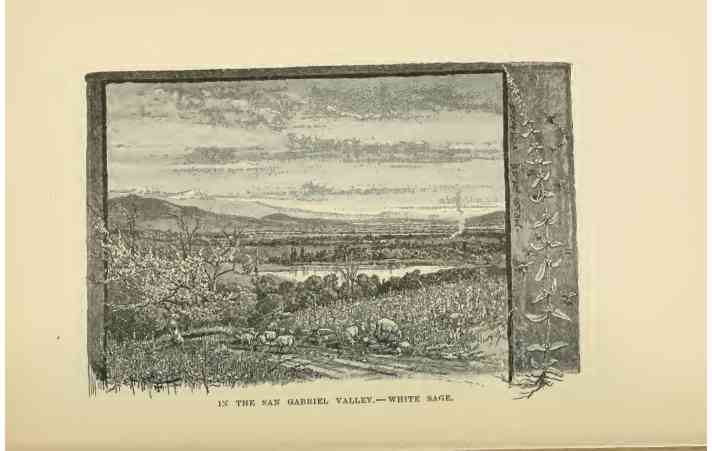
On bright, crisp mornings a striking optical effect may frequently be observed from the shadows of the higher mountains while the sunbeams are pouring past overhead. Then every insect, no matter what may be its own proper color, burns white in the light. Gauzy-winged hymenoptera, moths, jet-black beetles, all are transfigured alike in pure, spiritual white, like snowflakes. In Southern California, where bee-culture has had so much skilful attention of late years, the pasturage is not more abundant, or more advantageously varied as to the number of its honey plants and their distribution over mountain and plain, than that of many other portions of the State where the industrial currents flow in other channels. The famous White Sage (Audibertia), belonging to the mint family, flourishes here in all its glory, blooming in May, and yielding great quantities of clear, pale honey, which is greatly prized in every market it has yet reached. This species grows chiefly in the valleys and low hills. The Black Sage on the mountains is part of a dense, thorny chaparral, which is composed chiefly of adenostoma, ceanothus, manzanita, and cherry — not differing greatly from that of the southern portion of the Sierra, but more dense and continuous, and taller, and remaining longer in bloom. Stream-side gardens, so charming a feature of both the Sierra and Coast Mountains, are less numerous in Southern California, but they are exceedingly rich in honey-flowers, wherever found, — melilotus, columbine, collinsia, verbena, zauschneria, wild rose, honeysuckle, philadelphus, and lilies rising from
[page] 367
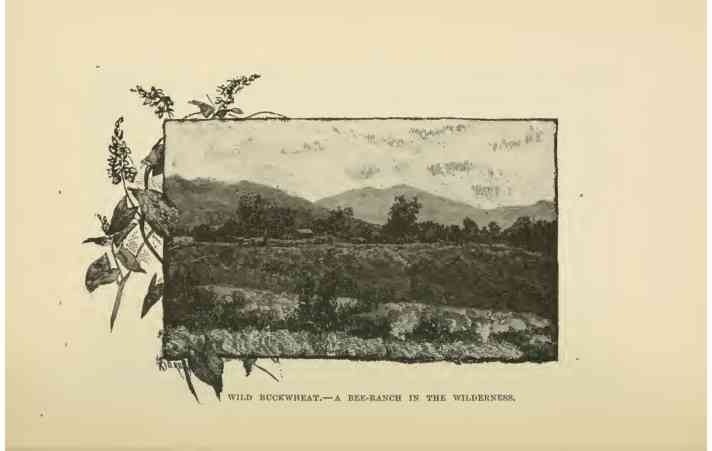
the warm, moist dells in a very storm of exuberance. Wild buckwheat of many species is developed in abundance over the dry, sandy valleys and lower slopes of the mountains, toward the end of summer, and is, at this time, the main dependence of the bees, reinforced here and there by orange groves, alfalfa fields, and small home gardens. The main honey months, in ordinary seasons, are April, May, June, July, and August; while the ether months are usually flowery enough to yield sufficient for the bees. According to Mr. J. T. Gordon, President of the Los Angeles County Bee-keepers' Association, the first bees introduced into the county were a single hive, which cost $150 in San Francisco, and arrived in September, 1854. [footnote 1] In April, of the following year, this hive sent out two swarms, which were sold for $100 each. From this small beginning the bees gradually multiplied to about 3000 swarms in the year 1873. In 1876 it was estimated that there were between 15,000 and 20,000 hives in the county, producing an annual yield of about 100 pounds to the hive — in some exceptional cases, a much greater yield. In San Diego County, at the beginning of the season of 1878, there were about 24,000 hives, and the shipments from the one port of San Diego for the same year, from July 17 to November 10, were 1071 barrels, 15,544 cases, and nearly 90 tons. The
[footnote]1 fifteen hives of Italian bees were introduced into Los Angeles (Jounty in 1855, and in 1876 they had increased to 500. The marked superiority claimed for them over the common species is now attracting considerable attention[footnote]
[page] 368
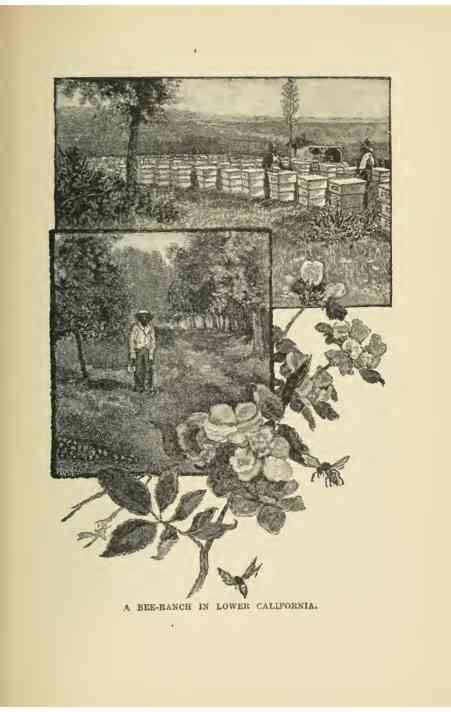
largest bee-ranches have about a thousand hives, and are carefully and skilfully managed, every scientific appliance of merit being brought into use. There are few bee-keepers, however, who own half as many as this, or who give their undivided attention to the business. Orange culture, at present, is heavily overshadowing every other business. A good many of the so-called bee-ranches of Los Angeles and San Diego counties are still of the rudest pioneer kind imaginable. A man unsuccessful in everything else hears the interesting story of the profits and comforts of bee-keeping, and concludes to try it; he buys a few colonies, or gets them from some overstocked ranch on shares, takes them back to the foot of some canon, where the pasturage is fresh, squats on the land, with, or without, the permission of the owner, sets up his hives, makes a box-cabin for himself, scarcely bigger than a bee-hive, and awaits his fortune. Bees suffer sadly from famine during the dry years which occasionally occur in the southern and middle portions of the State. If the rainfall amounts only to three or four inches, instead of from twelve to twenty, as in ordinary seasons, then sheep and cattle die in thousands, and so do these small, winged cattle, unless they are carefully fed, or removed to other pastures. The year 1877 will long be remembered as exceptionally rainless and distressing. Scarcely a flower bloomed on the dry valleys away from the stream-sides, and not a single grain-field depending upon rain was reaped. The seed only sprouted, came up a little way, and
[illus. page 369]
[page] 370
withered. Horses, cattle, and sheep grew thinner day by day, nibbling at bnshes and weeds, along the shallowing edges of streams, many of which were dried np altogether, for the first time since the settlement of the country. In the course of a trip I made during the summer of that year through Monterey, San Luis Obispo, Santa Barbara, Ventura, and Los Angeles counties, the deplorable effects of the drought were everywhere visible — leafless fields, dead and dying cattle, dead bees, and half -dead people with dusty, doleful faces. Even the birds and squirrels were in distress, though their suffering was less painfully apparent than that of the poor cattle. These were falling one by one in slow, sure starvation along the banks of the hot, sluggish streams, while thousands of buzzards correspondingly fat were sailing above them, or standing gorged on the ground beneath the trees, waiting with easy faith for fresh carcasses. The quails, prudently considering the hard times, abandoned all thought of pairing. They were too poor to marry, and so continued in flocks all through the year without attempting to rear young. The ground-squirrels, though an exceptionally industrious and enterprising race, as every farmer knows, were hard pushed for a living; not a fresh leaf or seed was to be found save in the trees, whose bossy masses of dark green foliage presented a striking contrast to the ashen baldness of the ground beneath them. The squirrels, leaving their accustomed feeding-grounds, betook themselves to the leafy oaks to gnaw out the acorn stores of the provident wood-
[illus. page 371]
[page] 372
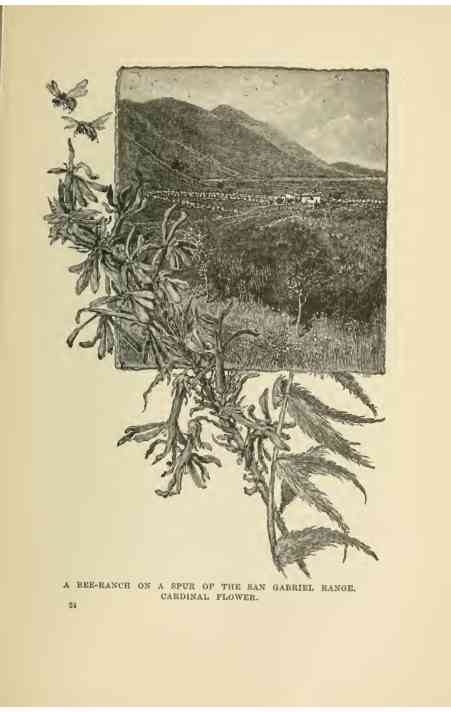
peckers, but the latter kept up a vigilant watch upon their movements. I noticed four woodpeckers in league against one squirrel, driving the poor fellow out of an oak that they claimed. He dodged round the knotty trunk from side to side, as nimbly as he could in his famished condition, only to find a sharp bill everywhere. But the fate of the bees that year seemed the saddest of all. In different portions of Los Angeles and San Diego counties, from one half to three fourths of them died of sheer starvation. Not less than 18,000 colonies perished in these two counties alone, while in the adjacent counties the death-rate was hardly less. Even the colonies nearest to the mountains suffered this year, for the smaller vegetation on the foot-hills was affected by the drought almost as severely as that of the valleys and plains, and even the hardy, deep-rooted chaparral, the surest dependence of the bees, bloomed sparingly, while much of it was beyond reach. Every swarm could have been saved, however, by promptly supplying them with food when their own stores began to fail, and before they became enfeebled and discouraged; or by cutting roads back into the mountains, and taking them into the heart of the flowery chaparral. The Santa Lucia, San Rafael, San Gabriel, San Jacinto, and San Bernardino ranges are almost untouched as yet save by the wild bees. Some idea of their resources, and of the advantages and disadvantages they offer to bee-keepers, may be formed from an excursion that I made into the San Gabriel Range about the beginning of August
[page] 373
of "the dry year." This range, containing most of the characteristic features of the oilier ranges just mentioned, overlooks the Los Angeles vineyards and orange groves from the north, and is more rigidly inaccessible in the ordinary meaning of the word than any other that I ever attempted to penetrate. The slopes are exceptionally steep and insecure to the foot, and they are covered with thorny bushes from five to ten feet high. With the exception of little spots not visible in general views, the entire surface is covered with them, massed in close hedge growth, sweeping gracefully down into every gorge and hollow, and swelling over every ridge and summit in shaggy, ungovernable exuberance, offering more honey to the acre for half the year than the most crowded cloverfield. But when beheld from the open San Gabriel Valley, beaten with dry sunshine, all that was seen of the range seemed to wear a forbidding aspect. From base to summit all seemed gray, barren, silent, its glorious chaparral appearing like dry moss creeping over its dull, wrinkled ridges and hollows. Setting out from Pasadena, I reached the foot of the range about sundown; and being weary and heated with my walk across the shadeless valley, concluded to camp for the night. After resting a few moments, I began to look about among the flood-boulders of Eaton Creek for a camp-ground, when I came upon a strange, dark-looking man who had been chopping cordwood. He seemed surprised at seeing me, so I sat down with him on the live-oak I02' he had been cutting, and made
[page] 374
haste to give a reason for my appearance in his solitude, explaining that I was anxious to find out something about the mountains, and meant to make my way up Eaton Creek next morning. Then he kindly invited me to camp with him, and led me to his little cabin, situated at the foot of the mountains, where a small spring oozes out of a bank overgrown with wild-rose bushes. After supper, when the daylight was gone, he explained that he was out of candles; so we sat in the dark, while he gave me a sketch of his life in a mixture of Spanish and English. He was born in Mexico, his father Irish, his mother Spanish. He had been a miner, rancher, prospector, hunter, etc., rambling always, and wearing his life away in mere waste; but now he was going to settle down. His past life, he said, was of "no account," but the future was promising. He was going to "make money and marry a Spanish woman." People mine here for water as for gold. He had been running a tunnel into a spur of the mountain back of his cabin. "My prospect is good," he said, "and if I chance to strike a good, strong flow, I '11 soon be worth $5000 or $10,000. For that flat out there," referring to a small, irregular patch of bouldery detritus, two or three acres in size, that had been deposited by Eaton Creek during some flood season, — "that flat is large enough for a nice orange grove, and the bank behind the cabin will do for a vineyard, and after watering my own trees and vines I will have some water left to sell to my neighbors below me, down the valley. And then," he continued, "I can keep bees, and make money
[illus. page 375]
[page] 376
that way, too, for the mountains above here are just full of honey in the summer-time, and one of my neighbors down here says that he will let me have a whole lot of hives, on shares, to start with. You see I 've a good thing; I 'm all right now." All this prospective affluence in the sunken, boulder-choked flood-bed of a mountain-stream! Leaving the bees out of the count, most fortune-seekers would as soon think of settling on the summit of Mount Shasta. Next morning, wishing my hopeful entertainer good luck, I set out on my shaggy excursion. About half an hour's walk above the cabin, I came to "The Fall," famous throughout the valley settlements as the finest yet discovered in the San Gabriel Mountains. It is a charming little thing, with a low, sweet voice, singing like a bird, as it pours from a notch in a short ledge, some thirty-five or forty feet into a round mirror-pool. The face of the cliff back of it, and on both sides, is smoothly covered and embossed with mosses, against which the white water shines out in showy relief, like a silver instrument in a velvet case. Hither come the San Gabriel lads and lassies, to gather ferns and dabble away their hot holidays in the cool water, glad to escape from their common place palm-gardens and orange-groves. The delicate maidenhair grows on fissured rocks within reach of the spray, while broad-leaved maples and sycamores cast soft, mellow shade over a rich profusion of bee-flowers, growing among boulders in front of the pool — the fall, the flowers, the bees, the ferny rocks, and leafy shade forming a charming little
[page] 377
poem of wildness, the last of a series extending down the flowery slopes of Mount San Antonio through the rugged, foam-beaten bosses of the main Eaton Canon. From the base of the fall I followed the ridge that forms the western rim of the Eaton basin to the summit of one of the principal peaks, which is about 5000 feet above sea-level. Then, turning eastward, I crossed the middle of the basin, forcing a way over its many subordinate ridges and across its eastern rim, having to contend almost everywhere with the floweriest and most impenetrable growth of honey-bushes I had ever encountered since first my mountaineering began. Most of the Shasta chaparral is leafy nearly to the ground; here the main stems are naked for three or four feet, and interspiked with dead twigs, forming a stiff chevaux defrise through which even the bears make their way with difficulty. I was compelled to creep for miles on all fours, and in following the bear-trails often found tufts of hair on the bushes where they had forced themselves through. For 100 feet or so above the fall the ascent was made possible only by tough cushions of club-nx>ss that clung to the rock. Above this the ridge weathers away to a thin knife-blade for a few hundred yards, and thence to the summit of the range it carries a bristly mane of chaparral. Here and there small openings occur on rocky places, commanding fine views across the cultivated valley to the ocean. These I found by the tracks were favorite outlooks and resting-places for the wild animals — bears, wolves, foxes, wildcats, etc. — which abound here,
[page] 378
and would have to be taken into account in the establishment of bee-ranches. In the deepest thickets I found wood-rat villages — groups of huts four to six feet high, built of sticks and leaves in rough, tapering piles, like musk-rat cabins. I noticed a good many bees, too, most of them wild. The tame honey-bees seemed languid and wing-weary, as if they had come all the way up from the flowerless valley. After reaching the summit I had time to make only a hasty survey of the basin, now glowing in the sunset gold, before hastening down into one of the tributary canons in search of water. Emerging from a particularly tedious breadth of chaparral, I found myself free and erect in a beautiful park-like grove of Mountain Live Oak, where the ground was planted with aspidiums and brier-roses, while the glossy foliage made a close canopy overhead, leaving the gray dividing trunks bare to show the beauty of their interlacing arches. The bottom of the canon was dry where I first reached it, but a bunch of scarlet mimulus indicated water at no great distance, and I soon discovered about a bucketful in a hollow of the rock. This, however, was full of dead bees, wasps, beetles, and leaves, well steeped and simmered, and would, therefore, require boiling and filtering through fresh charcoal before it could be made available. Tracing the dry channel about a mile farther down to its junction with a larger tributary canon, I at length discovered a lot of boulder pools, clear as crystal, brimming full, and linked together by glistening streamlets just strong enough to sing audibly. Flowers in
[illus. page 379]
[page] 380
full bloom adorned their margins, lilies ten feet high, Larkspur, columbines, and luxuriant ferns, leaning and overarching in lavish abundance, while a noble old Live Oak spread its rugged arms over all. Here I camped, making my bed on smooth cobblestones. Next day, in the channel of a tributary that heads on Mount San Antonio, I passed about fifteen or twenty gardens like the one in which I slept — lilies in every one of them, in the full pomp of bloom. My third camp was made near the middle of the general basin, at the head of a long system of cascades from ten to 200 feet high, one following the other in close succession down a rocky, inaccessible canon, making a total descent of nearly 1700 feet. Above the cascades the main stream passes through a series of open, sunny levels, the largest of which are about an acre in size, where the wild bees and their companions were feasting on a showy growth of zauschneria, painted cups, and monardella; and gray squirrels were busy harvesting the burs of the Douglas Spruce, the only conifer I met in the basin. The eastern slopes of the basin are in every way similar to those we have described, and the same may be said of other portions of the range. From the highest summit, far as the eye could reach, the landscape was one vast bee-pasture, a rolling wilderness of honey-bloom, scarcely broken by bits of forest or the rocky outcrops of hilltops and ridges. Behind the San Bernardino Range lies the wild "sage-brush country," bounded on the east by the Colorado River, and extending in a general northerly direction to Nevada and along the eastern base of the Sierra beyond Mono Lake.
[page] 381
The greater portion of this immense region, including Owen's Valley, Death Valley, and the Sink of the Mohave, the area of which is nearly one fifth that of the entire State, is usually regarded as a desert, not because of any lack in the soil, but for want of rain, and rivers available for irrigation. Very little of it, however, is desert in the eyes of a bee. Looking now over all the available pastures of California, it appears that the business of bee-keeping is still in its infancy. Even in the more enterprising of the southern counties, where so vigorous a beginning has been made, less than a tenth of their honey resources have as yet been developed; while in the Great Plain, the Coast Ranges, the Sierra Nevada, and the northern region about Mount Shasta, the business can hardly be said to exist at all. What the limits of its developments in the future may be, with the advantages of cheaper transportation and the invention of better methods in general, it is not easy to guess. Nor, on the other hand, are we able to measure the influence on bee interests likely to follow the destruction of the forests, now rapidly falling before fire and the ax. As to the sheep evil, that can hardly become greater than it is at the present day. In short, notwithstanding the wide-spread deterioration and destruction of every kind already effected, California, with her incomparable climate and flora, is still, as far as I know, the best of all the bee-lands of the world.